BFSI Beyond Banking: Understanding the Industry and Its Career Ecosystem
Every year, millions of college graduates in India gear up for competitive exams, scrolling through endless job notifications with a single goal in mind: "landing a bank job". For most, the mental image of the BFSI sector is rigidly confined to public-sector bank Probationary Officer (PO) exams, teller counters, branch operations, and processing home loans or fixed deposits.
While banking remains a massive engine of employment across India, viewing the entire industry through this single lens is like looking at an iceberg and seeing only the tip above the water.
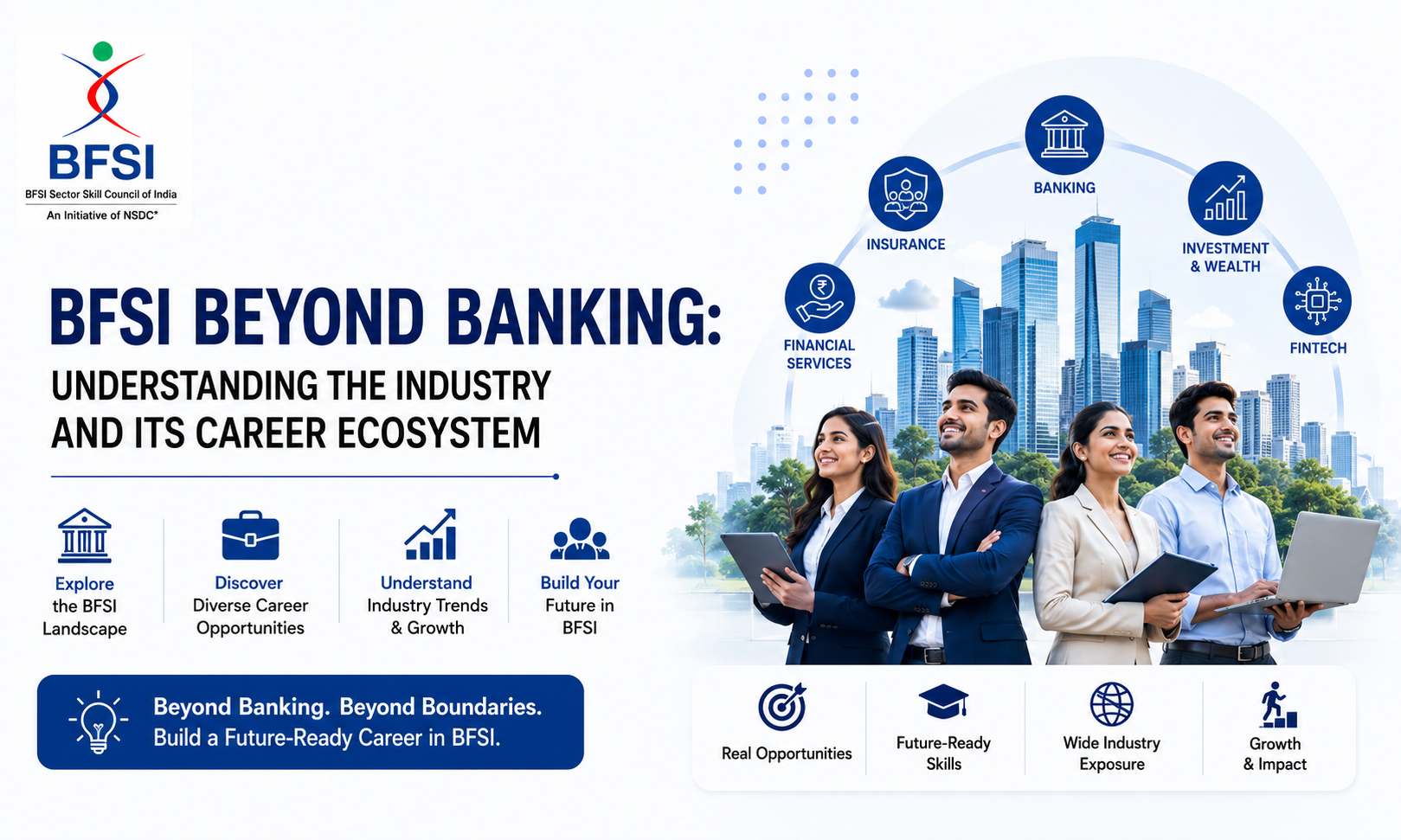
BFSI stands for Banking, Financial Services, and Insurance. It is not a single monolith or a list of government exams; it is a deeply interconnected, trillion-dollar career ecosystem. When students limit their search strictly to "bank jobs", they inadvertently blind themselves to thousands of entry-level opportunities across Non-Banking Financial Companies (NBFCs), Asset Management Companies (AMCs), wealth management firms, insurance underwriters, capital market brokerages, and Global Capability Centres (GCCs). Understanding what the BFSI landscape actually covers opens up a far wider, more resilient array of career pathways.
Why Understanding the BFSI Industry Matters
If your job hunt begins and ends with the search query "bank vacancy", you run two distinct risks: missing vast pools of unadvertised entry-level roles and landing in a job function that completely mismatches your innate strengths.
The traditional banking selection process in India is heavily exam-centric. Hundreds of thousands of candidates compete for a limited pool of PSU seats. Meanwhile, parallel segments of the financial sector are actively searching for talent with functional skills—numerical literacy, process discipline, or communication ability—who can step into operational, analytical, or relationship roles immediately.
A clear, structural understanding of the broader BFSI ecosystem helps you:
Discover hidden entry points: Look beyond public sector bank exams toward fast-growing private financial entities, fintech lenders, and back-office capability centres.
Align roles with your strengths: Match your natural aptitude—whether you enjoy client negotiation, meticulous process tracking, or deep data analysis—to the right functional bucket.
Avoid career burnout: Prevent the frustration of landing a high-pressure, target-driven sales role when your true skill lies in back-office risk analysis or underwriting support.
For graduates and young professionals starting out, stepping back to look at the full picture transforms your search from a desperate numbers game into a strategic career move.
What Is BFSI? Banking, Financial Services, and Insurance Explained
The BFSI sector operates as an interconnected economic machine where money is deposited, safely deployed, invested for growth, or protected against risk. In India, this entire system is anchored by key regulatory pillars: the Reserve Bank of India (RBI), the Securities and Exchange Board of India (SEBI), the Insurance Regulatory and Development Authority of India (IRDAI), and the Pension Fund Regulatory and Development Authority (PFRDA).
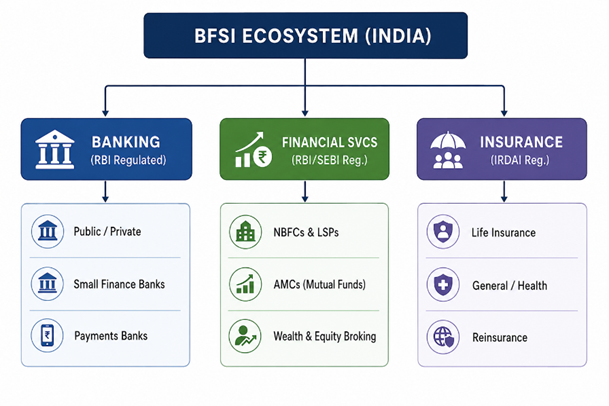
To understand where job opportunities exist, you must first understand how these pillars work together:
1. Banking (The Core System)
Banks form the financial bedrock of the country. They collect surplus cash from depositors and lend it to individuals, small businesses, and large corporations. Under RBI oversight, this segment includes:
Public & Private Sector Commercial Banks: Universal institutions providing everything from personal savings accounts to multi-crore corporate credit lines.
Small Finance Banks (SFBs): specialised institutions established to drive financial inclusion by lending to micro-enterprises, small farmers, and unorganised sector entities.
Payments Banks: Tech-driven engines built for high-volume, low-margin digital payments and remittances without offering direct credit cards or loans natively.
2. Financial Services (The Growth Engine)
Financial services extend far beyond traditional deposit-taking institutions. This pillar caters to specific credit, investment, and wealth management needs across the economy:
NBFCs & Fintechs: Non-Banking Financial Companies bridge critical credit gaps where traditional banks may move too slowly. In India’s modern digital lending landscape, many fintech apps operate as Lending Service Providers (LSPs) in strategic partnership with regulated NBFCs and banks.
Asset Management Companies (AMCs): AMCs manage institutional and retail capital through mutual funds, pooled investment vehicles, and Portfolio Management Services (PMS), handling tens of trillions of rupees in Assets Under Management (AUM).
Capital Markets & Wealth Management: Equity brokerages, depository participants (managing Demat accounts), and investment advisory firms that help individuals and institutions trade and grow wealth.
3. Insurance (The Risk Shield)
Insurers collect premiums from individuals and businesses to protect them against catastrophic financial loss, redistributing risk across pools of policyholders:
Life, Health, & General Insurance: Entities focused on safeguarding personal lives, medical emergencies, commercial property, supply chains, and crop protection.
Bancassurance Dynamics: A key trend in India where banks partner with life and general insurance providers to distribute policy products directly to existing bank account holders.
These three pillars do not operate in silos. A housing loan granted by an NBFC is frequently paired with a property insurance policy. A bank branch distributes mutual funds managed by an AMC. An insurance company invests its massive premium reserves back into corporate bonds issued by banks and NBFCs. The BFSI sector is a single, fluid network.
Types of Roles: Thinking in Functions, Not Job Titles
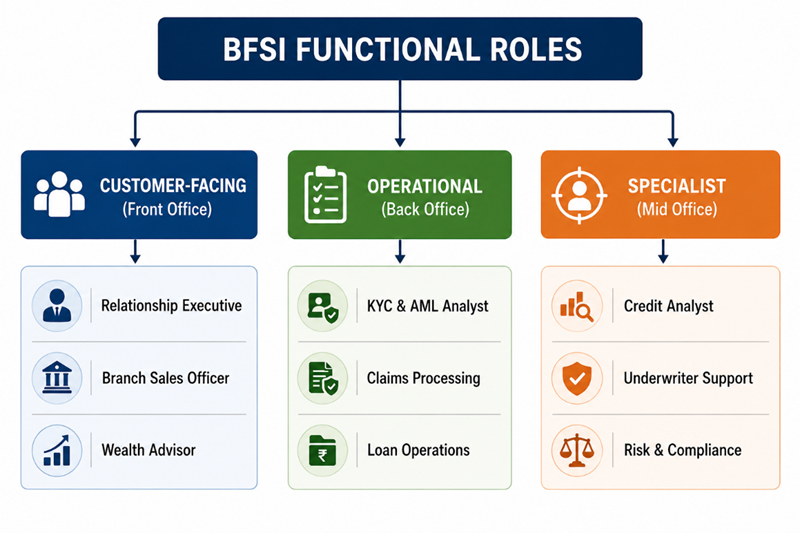
Instead of getting bogged down by impressive or confusing corporate job titles, learn to categorise work by its underlying functional focus. Every firm in the BFSI ecosystem—whether a large bank, a small NBFC, or an insurance startup—relies on three core types of functions:
1. Customer-Facing Roles (Front Office)
You work directly with clients to generate business, resolve issues, and build long-term relationships.
Common Titles: Relationship Manager (RM), Branch Sales Officer, Agency Manager, Wealth Advisor, and Customer Executive.
Core Aptitude Required: High emotional intelligence, active listening, resilience, clear verbal communication, and a strong grip on financial products.
2. Operational Roles (Back Office)
You run the backend processing engines that ensure transactions are legal, accurate, and fully compliant with regulations.
Common Titles: KYC (Know Your Customer) Executive, Loan Documentation Officer, Claims Processing Associate, Transaction Support Executive.
Core Aptitude Required: Meticulous attention to detail, process discipline, comfort with digital workflows, and strict adherence to turnaround times (TAT).
3. Specialist Roles (Mid Office)
You apply specialised domain knowledge, analytical models, or regulatory frameworks to evaluate risk and make business decisions.
Common Titles: Junior Credit Analyst, Risk Operations Analyst, Underwriting Support Associate, Compliance Officer, Data Analyst.
Core Aptitude Required: Strong numerical ability, working knowledge of financial statements, logical reasoning, and basic familiarity with risk metrics (such as CIBIL scores or DSCR calculations).
Real-World Context: How Thinking Beyond Banking Transforms a Career
Consider the scenario of Ananya, a recent commerce graduate from a Tier-2 college in India. Ananya is analytical, comfortable with numbers, and prefers structured, systematic work over client negotiation.
Guided by standard advice, Ananya spends a full year preparing exclusively for competitive bank exams. When the results come out, she misses the cutoff by a narrow margin. Feeling defeated, she applies for generic job listings and lands a trial offer as a Direct Sales Executive for a credit card distributor. Within three months, struggling with cold calling and aggressive daily quotas, she feels burnt out and concludes that she isn't cut out for the finance industry.
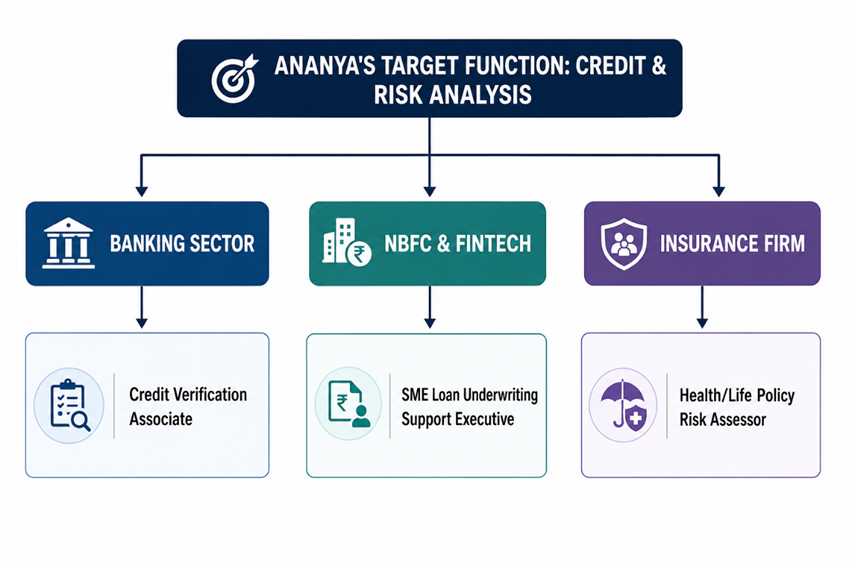
Now, imagine an alternate path where Ananya understands the broader BFSI ecosystem:
Instead of limiting herself to bank exams or generic sales roles, Ananya targets her preferred function: credit analysis and risk support. Recognising that her skills match mid-office operational analysis, she expands her job search across the ecosystem:
In an NBFC: She applies for an entry-level SME Loan Underwriting Support role, evaluating balance sheets and CIBIL reports for small business loans.
In an Insurance Firm: She explores claims assessment operations, reviewing medical and financial documents to verify coverage eligibility.
In a Global Capability Center (GCC): She lands a role as a Risk & Compliance Trainee for an international bank’s backend hub in Bengaluru or Hyderabad.
Same core skill set, completely different trajectory. By shifting her focus from job titles to industry functions, Ananya lands a career track where she can thrive.
What This Means for a BFSI Aspirant
If you are currently preparing to enter the job market, realizing that BFSI is an interconnected ecosystem changes how you approach your job search:
Multiple Entry Pathways: Public sector bank exams are one route among many. Private institutions, local NBFCs, insurance brokers, mutual fund houses, and back-office GCCs constantly recruit fresh talent based on practical, verifiable skills.
Transferable Skill Sets: Skills acquired in one part of the ecosystem easily transfer to another. Learning how KYC compliance works in a small payment company equips you to handle compliance at a major private bank or a mutual fund AMC later in your career.
Clearer Career Mobility: You are never stuck in one lane. Many professionals start in entry-level branch operations, transition into credit analysis at an NBFC, and eventually move into risk management at a capital markets firm.
Your Roadmap to Building a BFSI Career
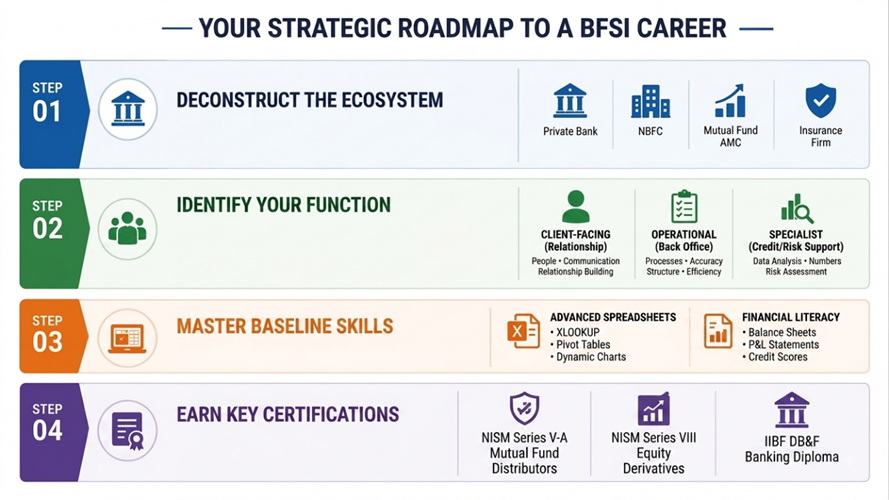
If you are ready to transition from passive reading to active exploration, follow this step-by-step action plan:
1. Understand the BFSI Ecosystem
Learn how different BFSI companies operate beyond traditional banks. Explore one company from each major segment: Private Bank, NBFC, Mutual Fund / AMC, and Insurance Company. Visit their official websites to understand their key products, services, customers, and business models.
2. Identify the Right Functional Role
Choose a career path based on your natural strengths and work style:
Customer-Facing Roles: Suitable if you enjoy interacting with customers and building relationships.
Operational Roles: Suitable if you prefer structured processes, accuracy, and documentation.
Credit & Risk Roles: Suitable if you enjoy working with numbers, financial data, balance sheets, and analysis.
3. Build Practical Skills
Don't rely only on generic skills such as "good communication". Focus on practical, job-relevant technical capabilities:
Excel & Spreadsheets: Master XLOOKUP, INDEX/MATCH, Pivot Tables and dynamic charts.
Financial Literacy: Learn to read a basic Balance Sheet and P&L statement, understand basic credit reports and CIBIL scores, and develop functional knowledge of loans, credit, and financial products.
4. Earn Industry-Recognized Certifications
Recognized domain certifications can strengthen your profile and demonstrate verified job-readiness to recruiters:
NISM Series V-A: Mutual Fund Distributors Certification (Useful for AMC, wealth management, and distribution roles).
NISM Series VIII: Equity Derivatives Certification (Useful for broking and capital-market roles).
IIBF DB&F: Diploma in Banking & Finance (useful for non-banking graduates looking to build recognized credentials).
Key Takeaways
BFSI is an ecosystem, not a single job category: It connects banking, financial services, and insurance into an integrated financial market.
Functions matter more than titles: Focus your career preparation around what you do daily—customer-facing, Operational processing, or Specialist analysis.
Skills travel across pillars: Core competencies in KYC compliance, credit assessment, spreadsheet modeling, and regulatory awareness are valuable across banks, NBFCs, AMCs, and fintechs alike.
Proactive skill-building creates direction: Earning recognized certifications (like NISM or IIBF) and mastering practical data tools give freshers a tangible edge over those relying solely on generic degrees.
Next Steps for Aspiring Professionals
Building a rewarding career in the financial sector starts with making informed, structured choices rather than relying on guesswork or limited public perception:
Explore BFSI Career Pathways: Investigate structured training, apprenticeship frameworks, and career pathways across banking, financial services, and insurance.
Build Targeted Skills: Align your technical, analytical, and interpersonal preparation directly with the functional track you wish to pursue.
Check Eligibility Requirements: Review age limits, educational criteria, and prerequisite qualifications carefully before applying for roles or registering for programmes.
Stay Informed: Keep learning about regulatory shifts, digital lending guidelines, and emerging trends shaping the Indian BFSI landscape through official BFSI Sector Skill Council of India (BFSI SSC) platforms.