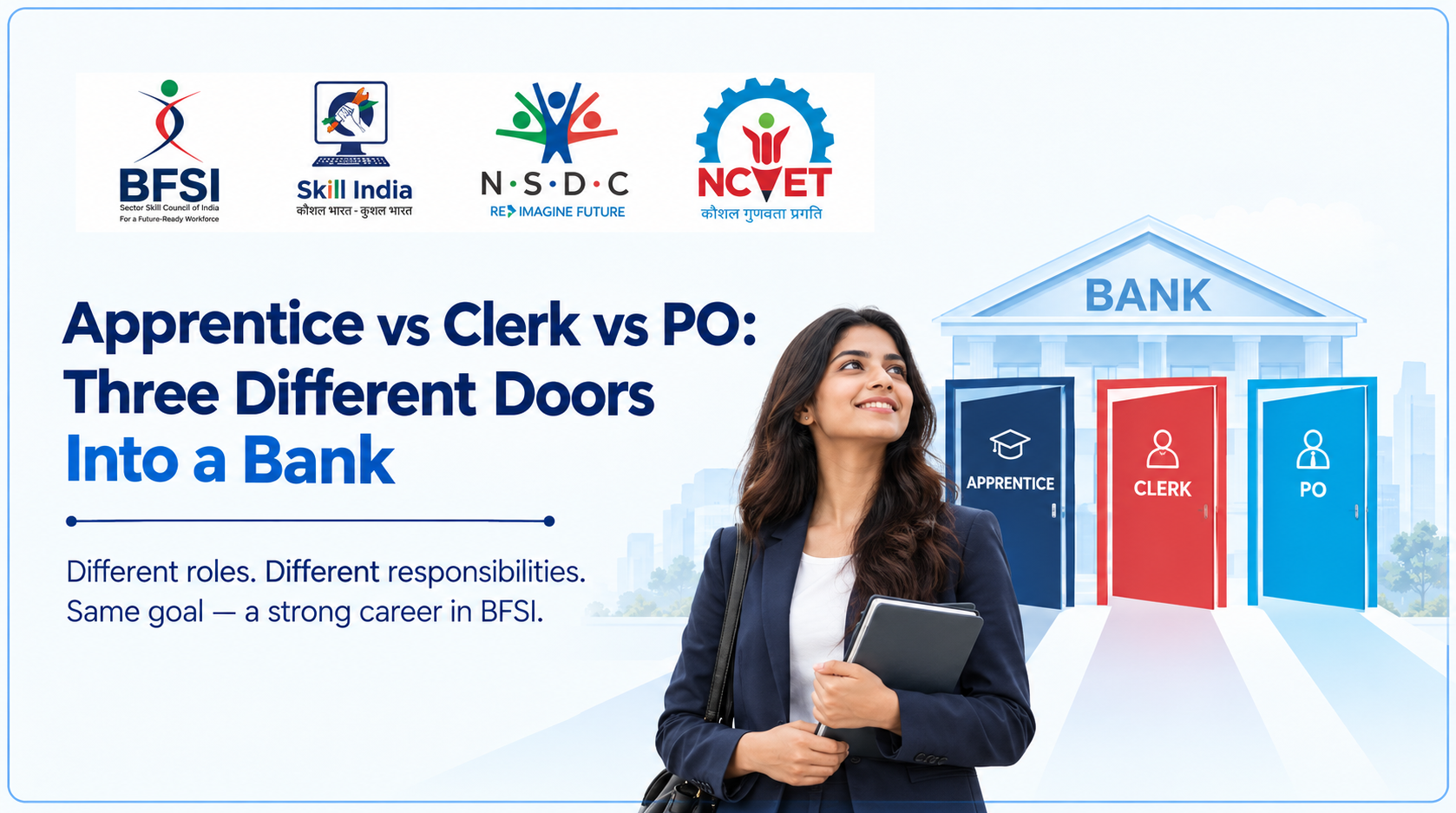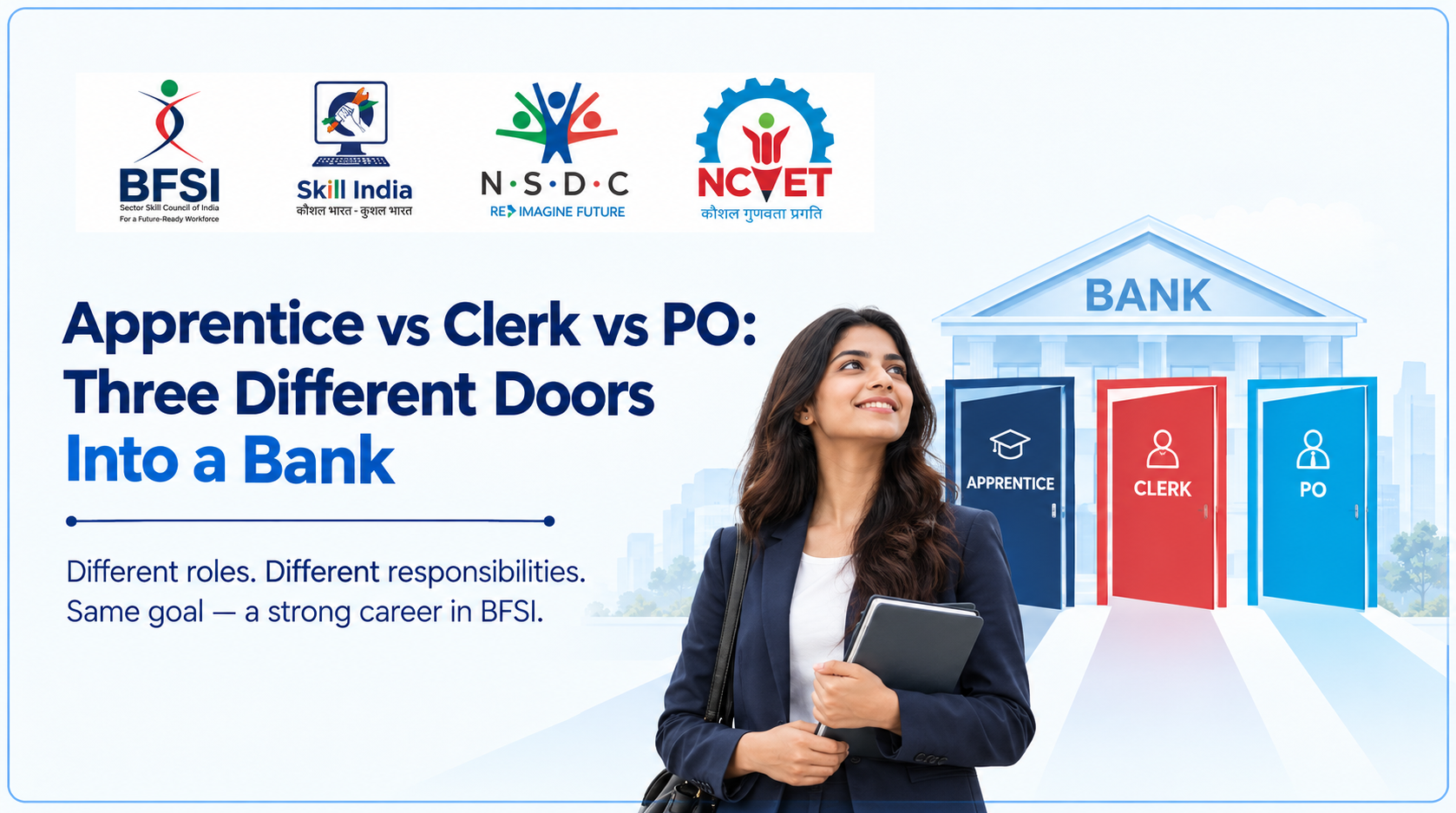
Apprentice vs Clerk vs PO: Three Different Doors Into a Bank
BFSI SSC Explainer | Updated September 2026
Same bachelor's degree. Same exam subjects. Same bank branch. So why do three graduates who look identical on paper end up on three completely different career tracks within a year?
That's the real story behind bank apprentice vs clerk vs PO — three legitimate doors into the banking sector, each built for a different stage of your career. The one most candidates underrate — and the one this page pays closest attention to — is the apprenticeship route: a certified, government-backed entry point that gets you real branch experience, a recognised credential, and (with the right bank) a genuine edge toward permanent roles later, all while you're still building toward Clerk or PO. Here's exactly how all three compare, so you can choose with your eyes open instead of by accident.
At a Glance
| Feature | Apprentice | Clerk (CSA) | PO |
| Legal status | Trainee (Apprentices Act, 1961) — not an employee | Permanent employee | Permanent employee (officer cadre) |
| Recruiter | Individual BFSI organisation (bank, insurance company, NBFC, financial services organisation, etc.) | IBPS (common process) | IBPS (common process) |
| Engagement | Fixed 1-year contract | Regular service, post-probation | Regular service, post-probation |
| Pay | Stipend: ₹12,300–₹15,000/month | Basic from ₹24,050/month + allowances | Basic from ₹48,480/month + allowances |
| What you gain | Certified BFSI experience + credentials — a head start toward Clerk, PO, or other roles | A permanent job, confirmed employee from day one | A permanent officer role, confirmed from day one with the promotion ladder open |
| Age limit | 20–28 years | 20–28 years | 20–30 years |
| Benefits | None (no PF/HRA/DA/pension) | Full (PF, HRA, DA, NPS) | Full (PF, HRA, DA, NPS) |
| 2026 vacancies | 5,000–7,150 per bank | 11,000+ (all-India) | 6,000–7,000 (all-India) |
Apprentice: A Training Contract, Not a Job
Engaged under the Apprentices Act, 1961, directly by a bank (in partnership with BFSI SSC for certification). Every notification states plainly: apprentices are trainees, not employees, and there's no obligation to offer a job afterward. You get a monthly stipend (₹12,300–₹15,000), real branch-floor exposure, and a joint National Apprenticeship Certificate (bank + NSDC/BFSI SSC)—the single fastest way to add verified, recruiter-recognised BFSI experience to your profile before you've even cleared a Clerk or PO exam. Selection is a single objective exam plus a local language test — no interview, no multi-stage elimination. SBI goes a step further, giving apprentices who complete the term satisfactorily recruitment weightage toward its own future Clerk hiring — a bank-specific edge, but a real one.
👉 Want to start with an apprenticeship? BFSI SSC lists live, verified bank apprenticeship openings and certifies every apprentice on completion — check current openings and register on the BFSI SSC portal to lock in your seat before the window closes.
Clerk (CSA): Your First Permanent Banking Job
Recruited via IBPS CRP-CSA, a centralised exam feeding multiple PSU banks. This is real, permanent employment: basic pay starts at ₹24,050/month, selection is Prelims + Mains (no interview, merit decided by Mains alone), and the age limit is 20–28. Selected candidates serve a probation period as employees, then get full benefits — PF, pension under NPS, HRA, DA, and increments.
PO: The Officer-Cadre Entry Point
Recruited via IBPS CRP-PO/MT into Junior Management Grade Scale I (JMGS-I)—a level above Clerk. Basic pay starts at ₹48,480/month (gross often ₹75,000–₹90,000 in metros with DA/HRA). Selection has three stages — Prelims, Mains (objective + descriptive), and an Interview that carries real weight. The age limit is 20–30. POs are confirmed officers after probation, on the promotion ladder toward Scale II, III, and beyond.
Apprentice vs Clerk: The Trade-Off
| Factor | Apprentice | Clerk |
| Speed to a paid seat | Faster — single-stage exam | Slower — two exam stages |
| Income growth | Fixed stipend, no increments | Grows with increments, DA/HRA |
| Nature of the role | A training role — early-career BFSI experience, not a destination | A permanent role — a solid destination in its own right |
| Resume value | Recent branch experience + certificate | Recognised permanent job title |
| Best used as | A stepping stone | A career destination, or base for PO later |
Bottom line: apprenticeship and a Clerk job serve different points in your journey, not competing prizes. Apprenticeship gives you certified, real-world BFSI experience and a credential recruiters recognise — often while you're still preparing for Clerk or PO. Where a bank has built in completion weightage, like SBI, that experience converts into a real edge; even where it hasn't, you enter your next exam cycle with actual banking-floor exposure your competitors won't have.
Which Door Fits You
- Most candidates should start here: Apprenticeship is the fastest legitimate entry into BFSI — real experience, a certified credential, and stipend income while you keep preparing for Clerk or PO. Just go in knowing it ends in 12 months with no guarantee attached.
- Ready for full Prelims + Mains prep, want permanence first? Clerk gets you there directly, with benefits from day one.
- Can handle a longer exam with a descriptive paper and interview, want a higher starting package and promotion ladder? PO is built for that, with two extra years of age room.
These aren't mutually exclusive over a career timeline — apprenticeship for experience, clerk while still an apprentice or soon after, PO in parallel or a later cycle. Starting with an apprenticeship doesn't cost you a shot at Clerk or PO — it strengthens it.
FAQs
Is an apprentice better than a clerk? Different purposes — apprenticeship is faster entry with no security; Clerk is permanent with full benefits, via a tougher exam.
Can an apprentice become a clerk automatically? No. Some banks (SBI) give completion-linked weightage, but it's bank-specific, not a guaranteed conversion.
Is PO higher than clerk? Yes — PO is an officer cadre (JMGS-I) with higher pay and a longer promotion ladder than the clerical cadre.
Does an apprentice get employee benefits? No — only the stipend. No PF, HRA, DA, or pension, since apprentices are trainees, not employees.
Ready to Take the Apprentice Route?
Every year, a small number of candidates get ahead of the clerk and PO rush by starting with a certified bank apprenticeship — real branch experience, a recognised credential, and a head start most competitors won't have.
BFSI SSC works directly with SBI, Bank of Baroda, PNB, Canara Bank, and other leading banks to certify apprentices under the National Apprenticeship framework.
✅ Check live bank apprenticeship openings for 2026–27.
✅ Confirm your eligibility in under 2 minutes.
✅ Register on the BFSI SSC portal and get certified.
Explore Bank Apprenticeship Openings on BFSI SSC →