Quick Summary: Financial institutions divide operations into three core layers: Front-Office (Sales & Relationships), Middle-Office (Risk & Compliance), and Back-Office (Operations & Tech). Match your natural skill set to the right layer to build a successful BFSI career.
📖 Read our companion guide: How the BFSI Industry Creates Career Opportunities for Young Professionals
What Happens Inside a Financial Institution?
Have you ever wondered what actually happens inside a bank, an insurance company, or a financial services firm after a customer opens an account, applies for a loan, or buys a policy?
A financial institution is not a single monolith; it is a highly coordinated ecosystem of specialized departments working in tandem. For fresh graduates, commerce students, and competitive exam aspirants, looking beyond generic titles like "bank job" and understanding this functional breakdown is the key to discovering high-growth careers across India's Banking, Financial Services, and Insurance (BFSI) sector.
3 Core Layers of Financial Institution Operations
Every regulated financial entity—from public sector banks to agile NBFCs and fintech platforms—divides its workforce into three operational layers:
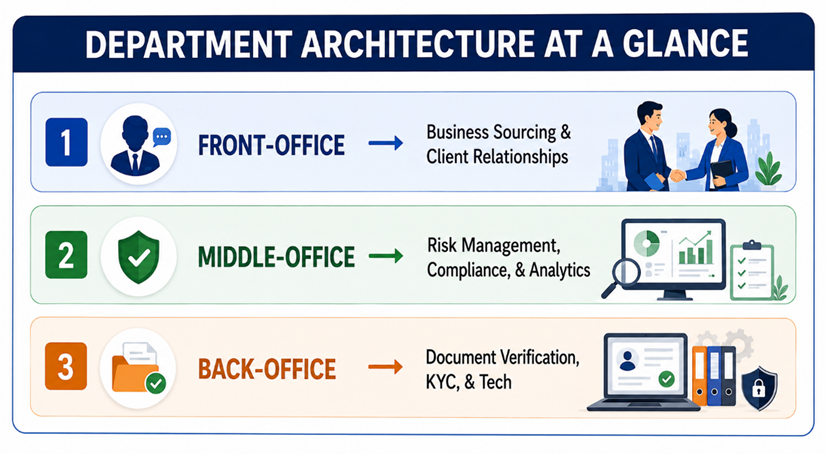
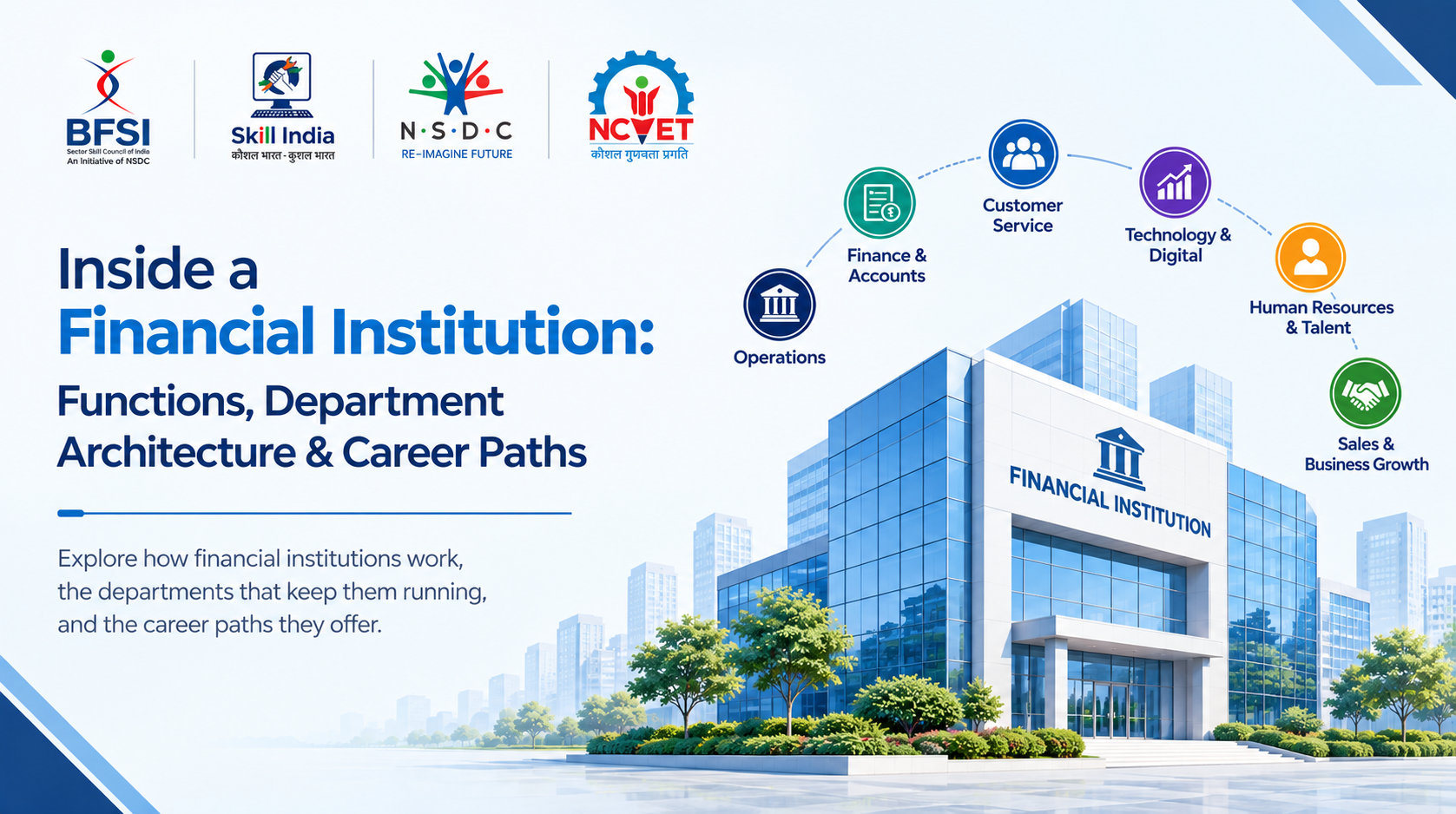
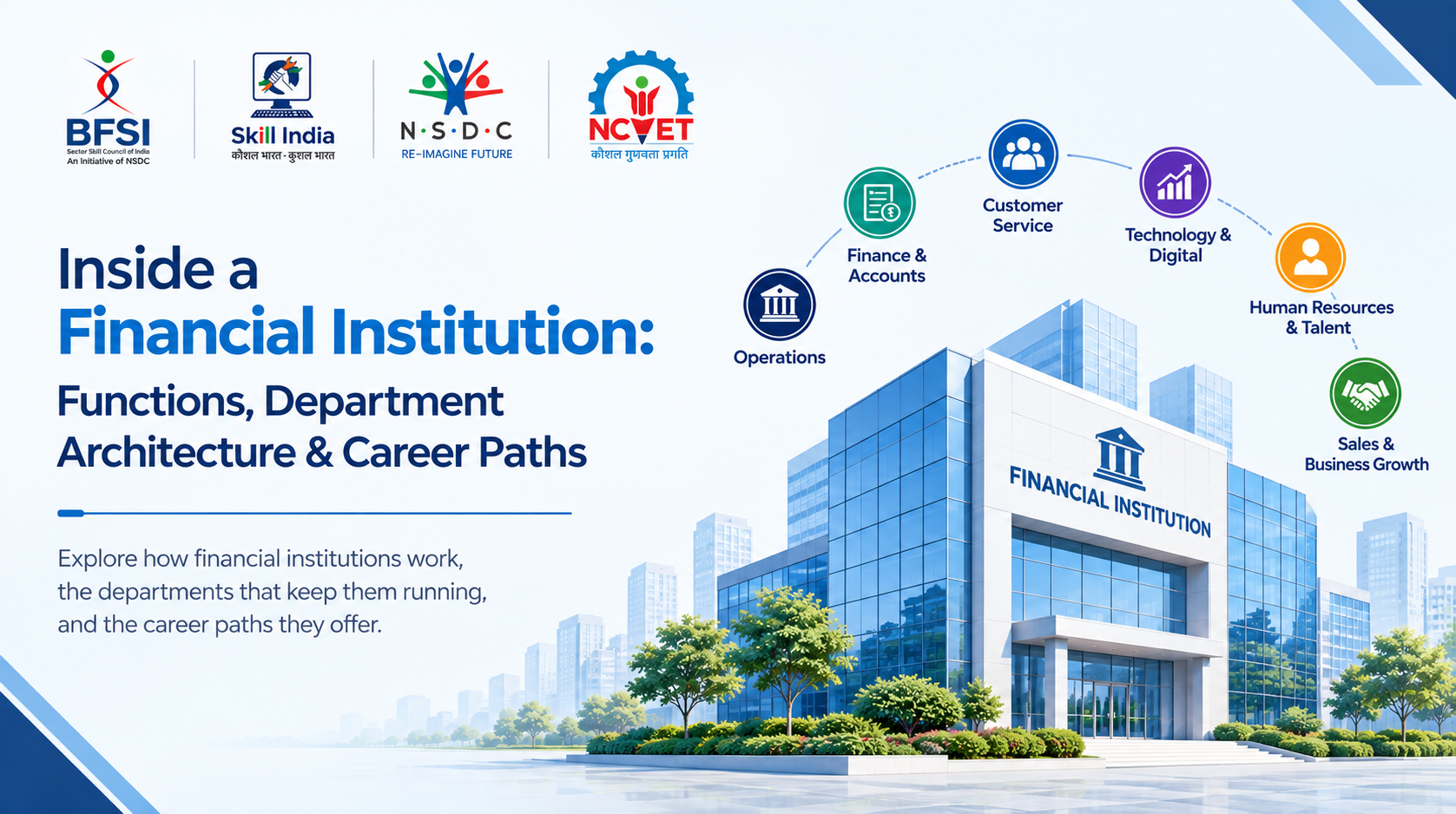
8 Essential Functions Driving Financial Services
1. Customer Acquisition (Front Office)
Customer acquisition teams are responsible for top-of-funnel business growth. They identify prospective borrowers, explain product terms, assist with application onboarding, and convert leads into active account holders.
- Primary Channels: Physical branch networks, direct sales agents (DSAs), field outreach, and digital lending applications.
- Essential Skills: Active listening, verbal communication, customer empathy, and product fluency.
- Common Entry Roles: Sales Officer, Relationship Executive, Customer Acquisition Associate.
2. Relationship Management (Front Office)
Once a client is onboarded, relationship management teams handle long-term account servicing. They evaluate changing client financial requirements, cross-sell relevant credit or investment options, and ensure long-term customer retention.
- Primary Focus: Building client trust, managing portfolio health, and delivering compliant financial advisory.
- Essential Skills: Financial literacy, emotional intelligence, and client negotiation.
- Common Entry Roles: Relationship Officer, Account Manager, Personal Banking Associate.
3. Central Operations & Processing (Back Office)
Operations acts as the execution engine of the institution. Teams in this function review application packages, cross-check identity records, process loan disbursements, update ledger accounts, and handle daily transaction clearing.
- Primary Focus: High processing accuracy, turnaround time (TAT) adherence, and error-free execution.
- Essential Skills: Process discipline, speed, attention to detail, and proficiency in MS Excel and internal CRM tools.
- Common Entry Roles: Operations Executive, KYC Verification Officer, Loan Processing Associate.
4. Customer Service & Support (Back Office / Hybrid)
Customer support teams handle everyday inquiries, track service requests, and resolve customer grievances across omni-channel touchpoints—including physical branches, call centers, email support desks, and mobile app ticketing.
- Primary Focus: First-contact resolution, client satisfaction, and systematic troubleshooting.
- Essential Skills: Patience, conflict resolution, clear verbal/written articulation, and CRM ticket tracking.
- Common Entry Roles: Helpdesk Officer, Customer Care Executive, Client Support Associate.
5. Risk Assessment & Regulatory Compliance (Middle Office)
Financial institutions must operate safely under guidelines set by regulatory authorities like the Reserve Bank of India (RBI), SEBI, and IRDAI.
- Risk Management Teams: Evaluate borrower repayment capacity, calculate Debt Service Coverage Ratios (DSCR), check CIBIL scores, and monitor credit risk exposure.
- Compliance Teams: Enforce Know Your Customer (KYC) norms, Anti-Money Laundering (AML) standards, and consumer protection policies.
- Essential Skills: Numerical reasoning, financial accounting, logical evaluation, and regulatory awareness.
- Common Entry Roles: Risk Operations Analyst, Junior Credit Analyst, Compliance Assistant.
6. Technology & Systems Infrastructure (Back Office)
Technology teams design, maintain, and secure the core digital frameworks supporting daily operations. This includes core banking systems (CBS), payment gateways (UPI), mobile banking apps, internal workflow platforms, and cybersecurity protocols.
- Primary Focus: High system availability, cyber threat prevention, and digital process optimization.
- Essential Skills: Tech literacy, system troubleshooting, and digital process awareness (advanced software development is not required for operational tech roles).
- Common Entry Roles: Digital Banking Assistant, System Support Executive, IT Operations Trainee.
7. Data Analytics & Business Intelligence (Middle Office)
Analytics teams transform raw operational and transaction data into actionable strategic insights. They evaluate borrower behavior, spot operational bottlenecks, monitor default risks, and support executive decision-making.
- Primary Focus: Predictive modeling, data visualization, and performance tracking.
- Essential Skills: Numerical comfort, spreadsheet modeling (XLOOKUP, Pivot Tables), and basic data interpretation.
- Common Entry Roles: Business Intelligence Associate, Data Operations Trainee, Reporting Analyst.
8. Product & Workflow Management (Middle Office)
- Product Management Teams: Design financial offerings—such as fixed-rate personal loans, micro-insurance policies, or digital gold products—that meet market demand.
- Workflow Optimization Teams: Audit internal processing steps to eliminate manual redundancies, lower turnaround times, and improve employee operational speed.
Mapping Your Skills to the Right Department Role
| Your Natural Strengths | Department Layer | Target Job Functions | Recommended Preparation |
| People skills, persuasion, active listening | Front-Office | Customer Acquisition, Relationship Management, Client Success | Practice product storytelling, verbal articulation, & client negotiation. |
| Meticulous organization, accuracy, rule-following | Back-Office | Central Operations, KYC Verification, Loan Processing | Master Advanced MS Excel, typing speed, & process documentation. |
| Data analysis, reading balance sheets, logic | Middle-Office | Risk Operations, Junior Credit Analysis, Compliance Support | Learn basic accounting principles, CIBIL metrics, & credit assessment. |
| Digital comfort, tool troubleshooting, logic | Back/Middle-Office | Tech Operations Support, Digital Banking, Workflow Optimization | Build digital platform literacy & learn core banking/lending app workflows. |
Strategic Action Steps for BFSI Career Aspirants
- Focus on Functional Skills Over Generic Titles: Stop searching solely for "bank vacancies." Target specific functions such as credit risk, KYC operations, or digital relationship management.
- Earn Recognized Professional Certifications: Strengthen your resume with industry-backed credentials, such as NISM modules or specialized domain certifications.
- Master Core Data Tools: Build working proficiency in spreadsheet tools (Microsoft Excel), basic accounting, and financial document interpretation.
- Leverage Formal Career Pathways: Utilize structured skill development programs and apprenticeship frameworks recognized by the BFSI Sector Skill Council of India (BFSI SSC) to connect directly with leading financial employers.
Explore BFSI Career Pathways & Qualification Standards
To learn more about recognized skill frameworks, national occupational standards, and certified training pathways across the Indian financial sector, visit the official BFSI Sector Skill Council of India (BFSI SSC) platform.