![Online Banking in India: Changing BFSI Careers [2026 Guide]](https://bfsissc.com/blog2/uploads/posts/6a968ba8cf04e.png)
Have You Ever Wondered Who Builds the Bank in Your Pocket?
Every time you send money through a UPI app, check your balance at midnight, or get a loan approved without visiting a branch, someone designed that system, someone secured it, and someone is monitoring it right now. Digital banking isn't just changing how India pays; it's quietly creating an entirely new map of BFSI careers. If you're a student or job seeker wondering where the opportunities are, this shift is one of the biggest signals to pay attention to.
What Is Online Banking and Why Is It Growing So Fast in India?
A decade ago, banking was closely associated with branches, paperwork and physical transactions. Today, many banking services can be accessed through digital channels.
The Unified Payments Interface (UPI), developed by the National Payments Corporation of India (NPCI), has become an important part of India's digital payments ecosystem. NPCI describes UPI as an instant payment system that enables users to transfer money between participating bank accounts through a UPI application.
The scale of adoption is significant:
- 23,201.93 million UPI transactions were processed in May 2026.
- The transactions were worth ₹29,90,424.21 crore.
- 720 banks were live on UPI during the month.
These figures illustrate the scale of India's digital payments ecosystem. But infrastructure alone does not make digital banking work. It requires people with the skills to build, operate, secure, analyse and support these systems.
Digital Banking and BFSI Careers: Why This Matters for Job Seekers
It's easy to see digital banking as a customer convenience story. For job seekers, it's more useful to see it as an employability story. Every layer of this system needs skilled people:
- Digital operations and customer experience — managing app-based banking journeys, resolving digital grievances, and supporting frameworks like the Integrated Ombudsman Scheme.
- Fraud monitoring and cybersecurity — as digital transaction volumes rise, so does the demand for specialists who can spot and prevent fraud in real time.
- Data and payments analytics — banks and fintechs constantly analyse transaction patterns, risk signals, and customer behavior.
- Compliance and RegTech — ensuring digital products align with evolving RBI, NPCI, and statutory regulatory guidelines.
- Financial inclusion initiatives — extending digital banking to semi-urban and rural regions, an area regulators and financial institutions prioritize.
Digital banking hasn't reduced the need for BFSI talent — it has redistributed it, shifting demand from traditional branch counters to tech, trust, and digital service roles.
UPI and Digital Banking in India: The Scale Behind the Screen
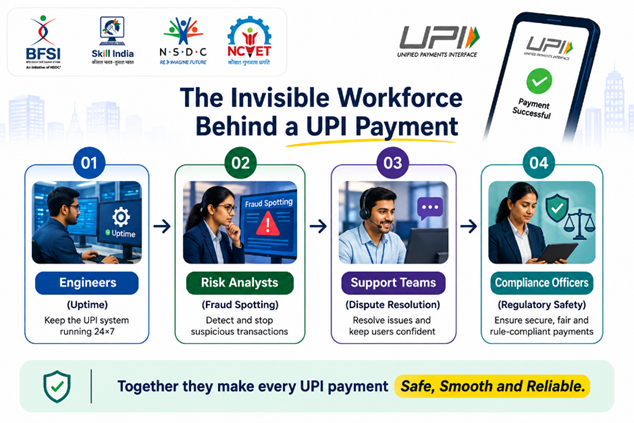
Consider what it takes to keep UPI running smoothly. The network now spans 731 live member banks as of mid-2026, handling transactions across every state, from high-volume metro hubs to rural regions adopting digital payments.
Behind every seamless transaction is an interconnected network of professionals: engineers maintaining infrastructure uptime, analysts tracking fraud patterns, operations teams resolving disputes, and compliance officers ensuring alignment with regulatory standards. This is the invisible workforce behind India's digital banking landscape — and it continues to grow.
Career Opportunities in India's Digital Banking Sector
If you're exploring a career in BFSI, digital banking is no longer an optional skill set — it is the primary focus. Roles in digital operations, payments technology, fraud risk management, compliance, and specialized customer support are expanding rapidly. Building foundational skills in digital literacy, customer service, basic data analysis, or regulatory fundamentals positions candidates effectively for current market demands.
This does not mean every role requires a programming background. The digital transformation of the BFSI sector requires a spectrum of capabilities — from customer-facing support and operational management to specialized technical positions. Success lies in being job-ready: understanding industry mechanics, tracking emerging trends, and acquiring industry-aligned skills.
Frequently Asked Questions About Online Banking Careers in India
Is online banking replacing traditional bank jobs in India?
No. Digital banking is redirecting job growth toward digital operations, cybersecurity, fraud analytics, compliance, and digital customer support rather than reducing overall employment in the sector.
What skills are needed for a career in digital banking?
Core competencies include financial and digital literacy, foundational data analysis, customer support capabilities, and knowledge of key financial regulations. Many roles do not require technical programming experience.
Which organizations regulate online banking and UPI in India?
Online banking operates under the regulatory oversight of the Reserve Bank of India (RBI). UPI is developed, managed, and operated by the National Payments Corporation of India (NPCI).
Are there entry-level opportunities in India's digital banking sector?
Yes. Market expansion has created entry-level pathways in digital operations, back-office compliance, digital customer onboarding, and merchant support alongside technical roles.
Ready to Build Your BFSI Career?
Digital banking will keep evolving — and so will the roles within it. Rather than waiting to see where the sector goes, start building your industry readiness today.
Explore recognized career pathways, assess your practical competencies, and check your eligibility for official industry skill programs:
👉 Explore Programs & Opportunities: https://bfsissc.com/BFSI-Employment-Exchange-Portal
👉 Connect & Follow Us for Job Alerts:
- LinkedIn: https://in.linkedin.com/company/bfsi-ssc
- Instagram: https://www.instagram.com/bfsi_ssc_/
- WhatsApp Community: https://whatsapp.com/channel/0029Vb6Up7ZGE56umD5Srr2X
Disclaimer: This content is for educational and informational purposes only and does not constitute financial, investment, or employment guarantees. Figures are derived from publicly available RBI and NPCI data accurate as of mid-2026.

![Online Banking in India: Changing BFSI Careers [2026 Guide]](https://bfsissc.com/blog2/uploads/thumbnails/6a968ba8d0cd2.png)